How to integrate full AI judgement automation on your SMT line
Turn AOI inspection experience into a shared strength.
Yamaha AI judgement automation helps you scale quality decisions across your SMT line - while keeping your team in control.
Why automate OK & NG judgements in SMT production?
- and how to do it without losing the human expertise
AOI inspection know-how are built on experience, attention to detail and skilled decision-making. With AI judgement automation, that expertise doesn’t disappear - it becomes part of a continuous support system that strengthens both quality and daily workflow.
Because AOI inspection verification is a critical part of any SMT line - and it relies on skilled people making the right decisions, every time. However, the work is repetitive and demanding, even for the most experienced inspectors.
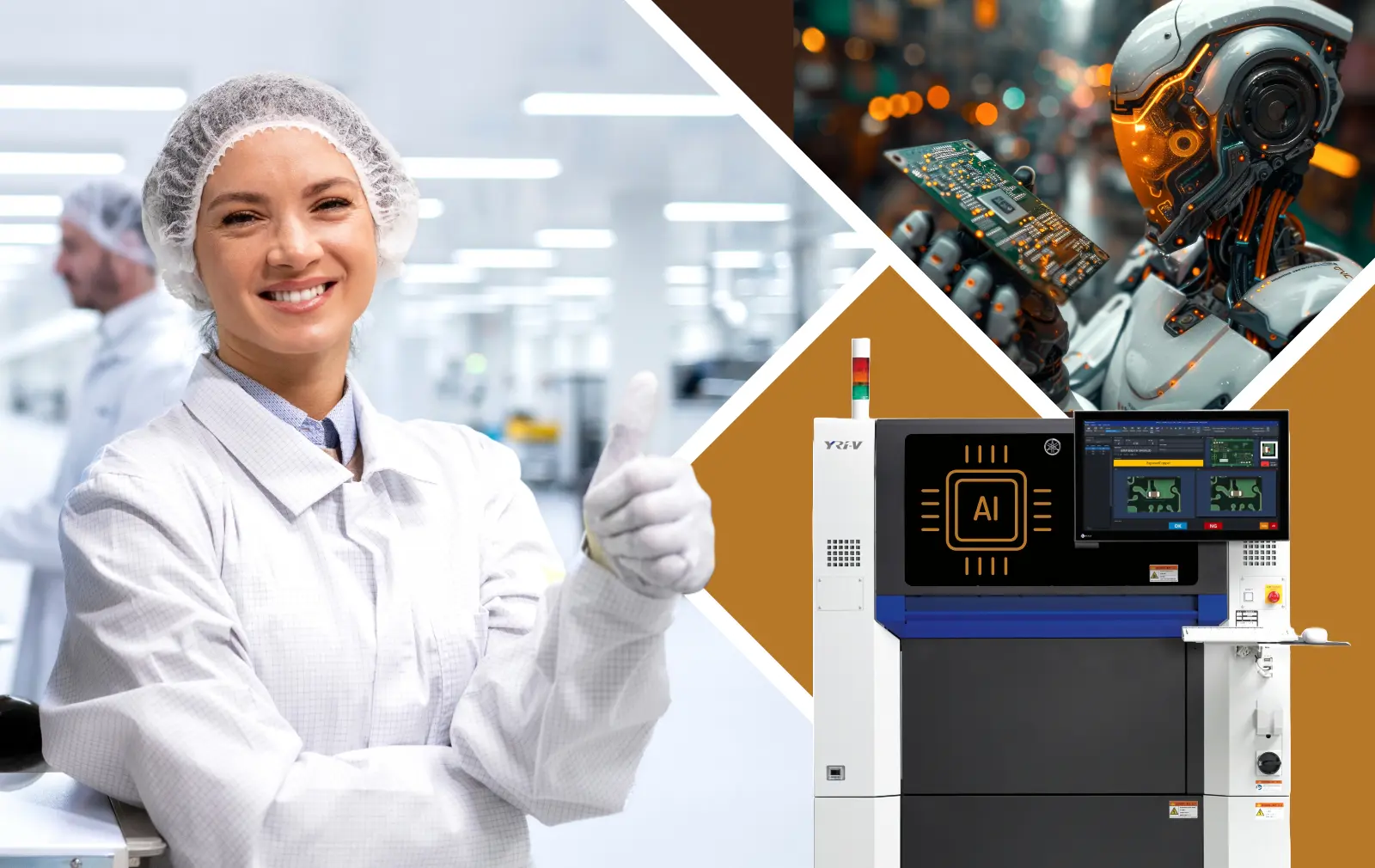
By training AI on real inspection data and decisions, you preserve the knowledge your team builds over time and make it accessible to everyone on the line. The result is a stronger, more consistent process where inspectors can focus on what they do best, while AI takes care of the repetitive evaluation.
It’s about creating a smarter workflow, improving quality, and making everyday work more engaging for the people who keep your production moving.
Yamaha AI judgement automation in 3 levels
Discover the operational
workflow of the AI judgement process
Judgement operator support
-
Display AI judgement results in repair station
- Support for less-experienced judgement operators enabling improved efficiency & accuracy
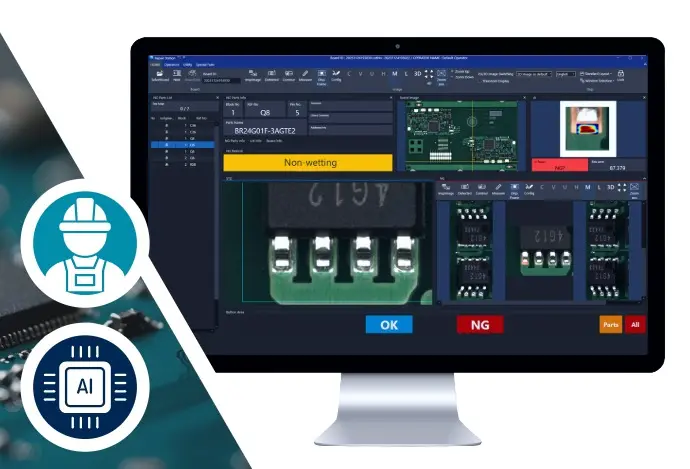
When a high accuracy AI model is achieved at 1st level, you can move to 2nd level.
Semi-automated 2nd-judgement
-
Automatically judge defects where the AI achieves high accuracy
- Reduce the number of cases that require judgement operators confirmation
- Reducing visual inspection cases
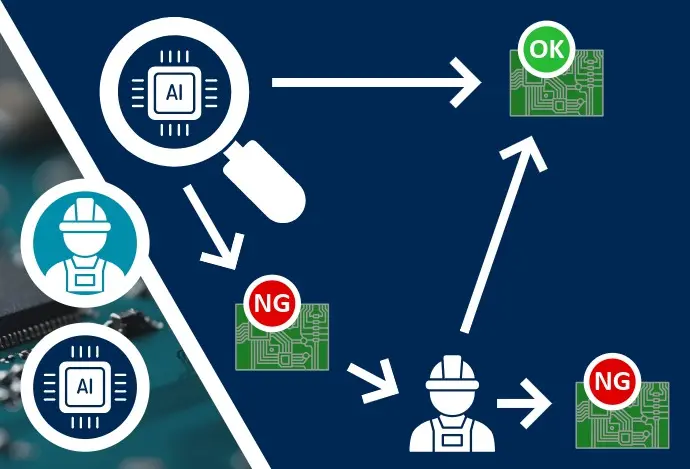
Once AI models are available for many component / inspection types, you can move onto 3rd level.
Full automation
- Automate the final judgement using AI decision
- Enable an automated line with intermediate conveyor integration
- For every component / inspection type, repeat the transition from 1st level ⇒ 3rd level to drive full automation
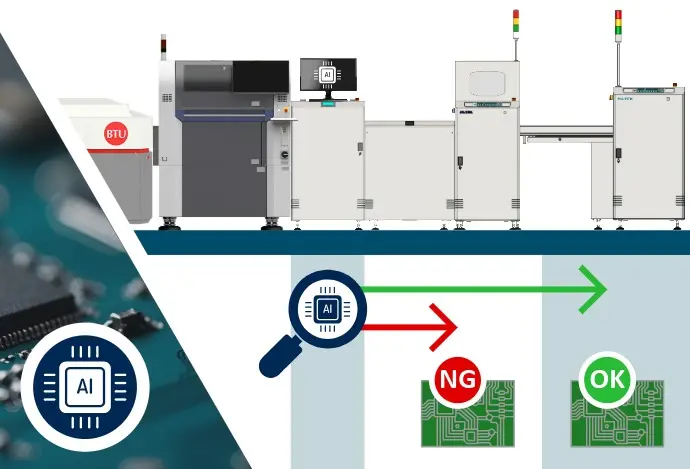
By running AI processing in-line rather than on the inspection machine, AI can be utilized without significantly reducing line takt time. Automated line still in experimental phase.
Training AI where decisions already happen
AI judgement automation is most powerful when it learns directly from real inspection work. By combining human expertise with live AOI feedback, you create a system that continuously improves accuracy, supports decision-making and strengthens the entire secondary judgement process.
How to train the secondary judgement process
One effective way to integrate Yamaha AI judgement automation is directly at the workstation level, where judgement operators already review assemblies rejected by AOI. Here, the AI becomes part of the secondary judgement process - supporting, not replacing, the existing workflow (1st level).
When a PCB board is flagged as NG, experienced judgement operators review the AOI images and data to confirm the judgement. If a false NG is identified, the board can be returned to production, while confirmed defects are routed for rework. Every decision made - both human and AI-supported - is captured and stored.
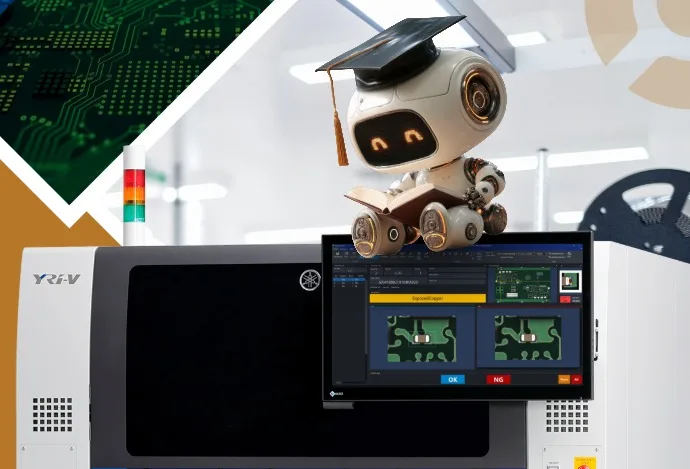
This is where the learning loop begins. The AI uses real inspection decisions to train its models continuously, improving its understanding of patterns, defects and issue cases over time. As confidence levels increase, the system gradually becomes capable of assisting in live inspection scenarios, offering a second opinion when needed.
Once the AI models reach a stable and high-confidence threshold, AI can begin supporting specific component types or defect categories with automated judgement. At this stage, the strength of the system lies in the combination: human experience guiding complex cases, and AI ensuring speed, consistency, and reduced operator fatigue in repetitive decisions.
For less experienced judgement operators, this support is especially valuable. The AI Judgement Station can present a clear recommendation together with a confidence score, helping operators make more informed decisions while building their own expertise over time. The result is a stronger inspection process - where learning, quality and throughput improve together on the SMT line.
Where to begin with AI judgement automation on your SMT line
Modern software tools now makes it possible to build and train AI models directly from your own production data.
This allows EMS and OEM manufacturers to take a practical first step into AI-supported inspection - starting small and scaling as confidence grows.
Software applications for AI-based inspection are now entering the SMT market and are already proving highly effective in identifying soldering defects such as insufficient solder or poor wetting from 2D AOI inspection data.
Solutions like Yamaha Robotics’ AI Judgement Station are designed to give manufacturers control over the entire AI learning process. Instead of relying on predefined models, users can build and train their own AI directly from real production data on the line.

The process starts by selecting representative OK and NG samples from existing AOI inspections. From here, the software automatically generates initial AI models, which are then trained using data collected continuously from daily production shifts. As more images are added, the model becomes increasingly refined, and users can monitor accuracy in real time to determine when performance stabilises.
- In practice, even a relatively small dataset - around 30 NG images combined with OK samples - can be enough to begin generating usable models.
- With continued learning, performance improves steadily, and after processing larger datasets (for example 1000+ images), the model can reach a very high level of accuracy.
Once trained, AI judgement operates extremely fast, typically delivering inspection feedback in around one second per case. This makes it a practical support tool for live production environments, where speed and consistency are critical.
AI and OCR in SMT inspection
Optical character recognition is one of the first areas where AI delivers immediate value on the SMT line - improving readability, reducing manual checks, and supporting consistent identification of critical markings.
One area where AI already demonstrates reliable, human-like judgement - and directly reduces judgement operator workload - is OCR (optical character recognition).
In traditional rules-based machine vision systems, character reading can quickly become a challenge. Low contrast, surface scratches, contamination, or partial obstruction from foreign material often lead to misreads or require manual verification. These conditions are common in surface-mount assembly environments and can directly affect the readability of critical information such as component values, date codes, polarity markings, and board identification.
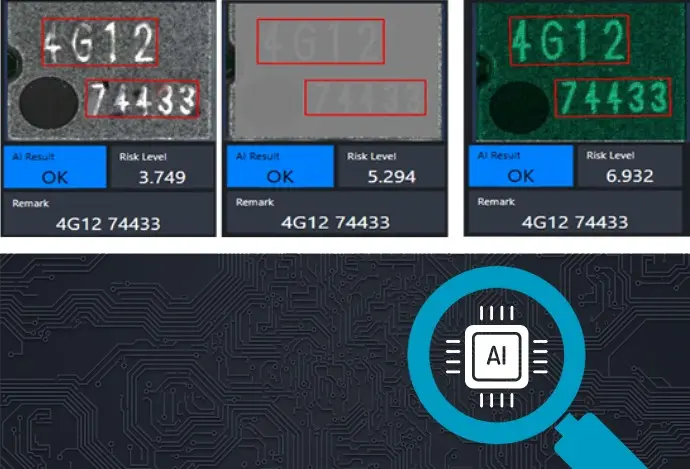
AI-OCR can read markings that otherwise would require judgement operator confirmation.
AI-based OCR approaches this problem differently. Instead of relying solely on fixed rules, it builds on learned patterns - making inferences in a similar way to human operators when text is partially damaged or difficult to read. This allows the system to interpret uncertain or degraded markings with a higher level of robustness.
The Yamaha AI Judgement Station package includes pre-trained AI-OCR models that can be used directly out of the box, without the need for additional training or fine-tuning. This enables manufacturers to introduce AI-supported character recognition quickly into existing inspection workflows, improving consistency while freeing up operators to focus on more complex judgement tasks.
From secondary judgement to inline AI inspection
As AI becomes embedded in daily SMT production workflows and continues learning from different judgement operators, the number of trained models increases to cover a wider range of components and defect types. With each iteration, confidence levels improve and fewer cases require manual confirmation.
This gradual build-up of validated models reduces dependency on individual experience in the secondary judgement process. Instead of relying on visual inspection as the final gate, decisions can increasingly be handled by AI with human oversight applied only where needed.
For SMT manufacturers, this approach does not represent a sudden shift, but a controlled progression. Judgement operators remain central in the early stages, guiding the system, validating edge cases and ensuring production quality is maintained throughout the learning phase.
The transition toward fully automated secondary judgement after training of all AI models.
Where AI handles inspection directly after AOI without requiring manual review in every case.
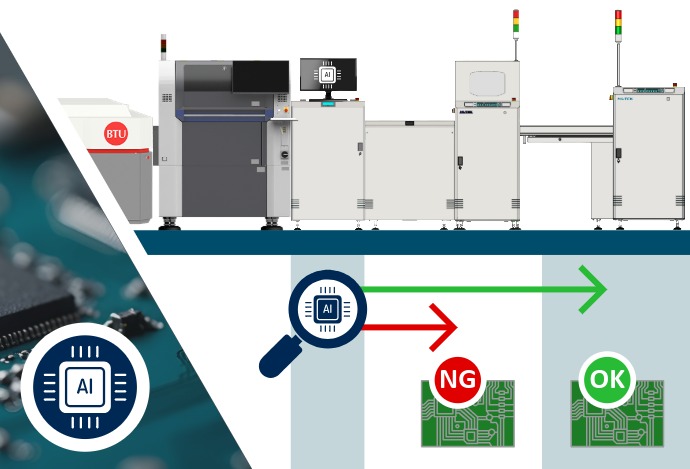
At the same time, AI reduces repetitive workload and supports decision-making in real time. This creates flexibility in how inspection strategies are applied - allowing manufacturers to balance caution, experience, and automation based on production risk and quality requirements.
In practice, solutions such as Yamaha’s AI Judgement Station provide a structured path forward: from assisted inspection, to partially automated judgement, and ultimately to inline AI-driven verification directly within the SMT line. This enables manufacturers to scale inspection capacity while maintaining consistency, traceability, and control over quality decisions.