SMD humidity cabinets
Keep your sensitive components safe with SMD humidity cabinets
Keep your sensitive components safe with SMD humidity cabinets
Moisture is invisible until it ruins a board. SMD humidity cabinets keep your moisture-sensitive components at a stable, low humidity, so every reel you pull is ready for the line. You skip the reflow defects, the rework and the extra bake cycles.
We supply humidity cabinets from Essegi, built for electronics production. Use one as a stand-alone dry cabinet next to the line, or as part of a complete storage solution system.
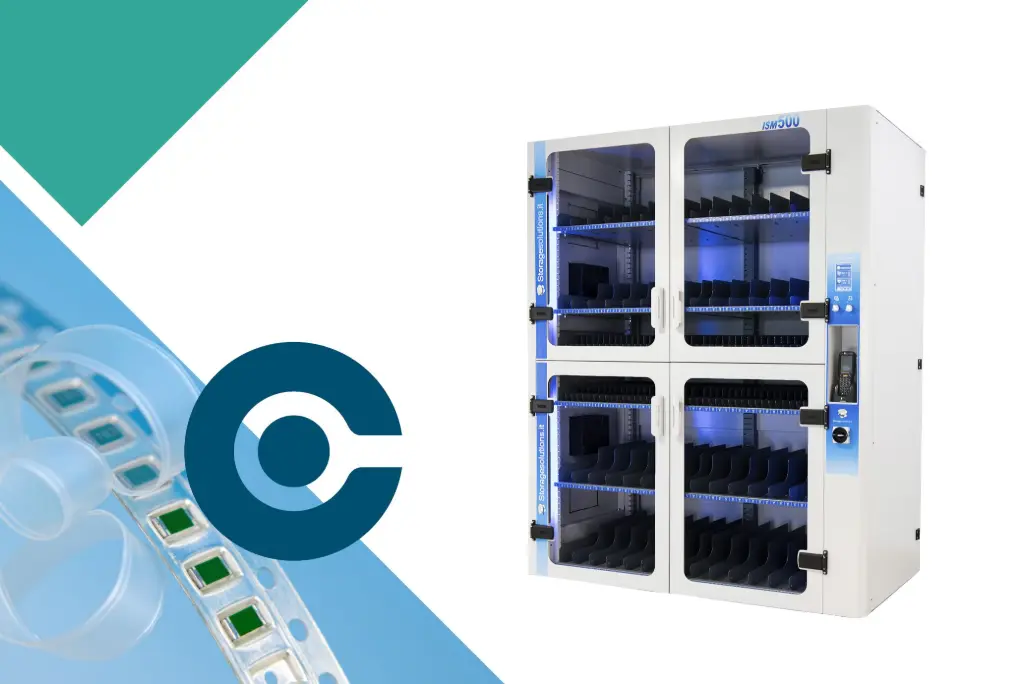
Essegi ISM 500 humidity cabinet
Dry, ESD-safe storage right where you need it.
Use the ISM 500 as a stand-alone humidity cabinet, or connect it to a complete storage solution system as your production grows.

Humidity cabinet expert guidance
Not sure how much dry storage you need?
Our experts know SMT production inside out and help you find the cabinet setup that fits your components, volumes and daily workflow.
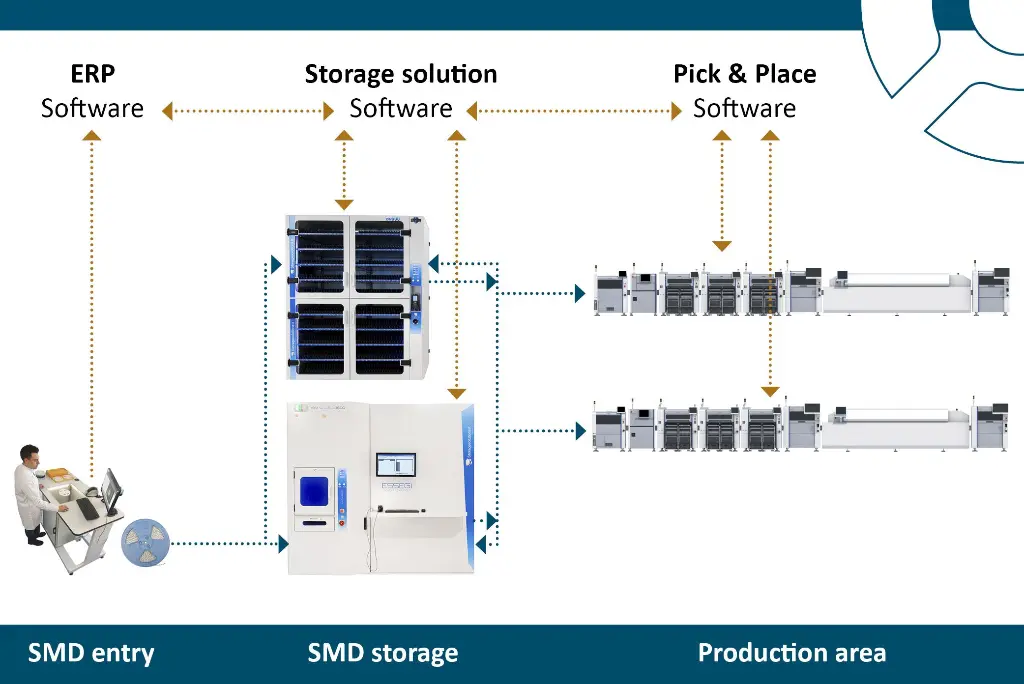
Storage solution system with humidity cabinets
Go beyond a single cabinet. Combine humidity cabinets with automated storage, so reels are stored, found and handed out faster, and you keep a clear overview of every component.
Why moisture is a risk in SMT production
Most SMD components come in plastic packages, and plastic absorbs moisture from the air. On the storage shelf, and you won't notice.
In the reflow oven, that trapped moisture turns to steam in seconds. The pressure can crack the package, separate its internal layers (delamination) or cause the well-known 'popcorn' effect.
The tricky part is that the damage is often invisible. A board can pass inspection and still fail later in the field.
Storing components in a humidity cabinet removes the problem at the source, before they ever reach the line.
MSL and floor life, made simple
Every moisture-sensitive device (MSD) has a moisture sensitivity level, or MSL, defined in the IPC/JEDEC J-STD-033 standard. The level tells you how long a component can be exposed to factory air after the dry bag is opened. This is called the floor life.
The level tells you how long a component can be exposed to factory air after the dry bag is opened – the so-called floor life. It ranges from unlimited at MSL 1 down to just a few days or less at the higher levels, and MSL 6 components must always be baked before use.
Once the bag is open, the clock is ticking. If a reel isn't used up in one job, you need a safe place to keep it. A dry cabinet with very low humidity is that place.
It protects opened components between jobs, and under certain conditions J-STD-033 allows dry storage to pause or help restore floor life, depending on MSL and exposure time.
Dry storage VS baking
Baking drives moisture out of components that have exceeded their floor life. It works, but it comes at a cost:
- It takes time: many hours, or even days at lower temperatures
- High temperatures can oxidise leads and reduce solderability
- Many tapes, reels and trays can't handle high bake temperatures
- The total bake time a component can take is limited
SMD humidity cabinets flip the logic. Instead of fixing moisture problems after they happen, you prevent them.
Baking is still there when you need it, but with proper dry storage you need it far less often.
The benefits of SMD humidity cabinets
- Fewer reflow defects. Dry components don't turn moisture into steam, so you avoid cracked packages and hidden failures.
- Less scrap and rework. Opened reels go back into the cabinet instead of being written off or sent for baking.
- More time producing. Components are ready when the line needs them, with no waiting for a bake cycle to finish.
- Better solderability. A stable, dry environment helps protect leads and terminations from oxidation.
- Protection on two fronts. ESD-safe storage keeps sensitive components safe from both moisture and electrostatic discharge.
- Easier quality control. Controlled storage conditions make it easier to show customers and auditors that MSDs are handled correctly.
What to look for in a humidity cabinet
Not all dry cabinets are the same. When you compare options, check:
- Humidity level: How low can it go, and how stable does it stay?
- Recovery time: How fast is the humidity back down after the door has been opened?
- Capacity: Is there room for your reel sizes, trays and future volumes?
- ESD protection: Are shelves and frame ESD-safe and grounded?
- Monitoring: Does it have a display, alarms and logging, so you always know the conditions?
- Scalability: Can the cabinet become part of a larger storage system later?
Our experts help you weigh these points against your production, so you don't pay for more, or less, than you need.
Where humidity cabinets fit in your workflow
Dry storage works best as part of a clear component flow: goods-in, counting, storage and kitting for the line.
Many manufacturers combine humidity cabinets with X-ray SMD counters for fast, accurate stock counts, and a storage solution system for quick access to reels.
See all our SMD storage options, or browse the full range of SMT supporting units.
FAQ about SMD humidity cabinets
For moisture-sensitive components, the goal is a very low and stable relative humidity, far below normal factory air.
The right level depends on the components you handle, so check the component manufacturer's recommendations or ask our experts.
Sometimes, for example if a component has been exposed far beyond its floor life, or if the manufacturer requires baking before use.
With good dry storage, though, baking becomes the exception rather than the routine.
Yes, and it's one of the main reasons to have one.
Returning opened reels to dry storage protects them until the next job.
t depends on your volumes and the number of reels you handle. A stand-alone humidity cabinet is a good start.
A storage system makes sense when you have many reels and want faster access. Ask our experts for advice on your setup.